Read Time
This Annapurna Base Camp Trek itinerary follows a seven-day route starting and ending in Pokhara. Your journey begins with a local jeep ride to Ghandruk before trekking towards Chhomrong and Dovan. From there, you continue to Machhapuchhre Base Camp and Annapurna Base Camp, with a planned overnight stay at each.
The return route passes through Sinuwa and Jhinu before a road transfer brings you back to Pokhara. Along the trail, expect stone steps, forest paths, mountain settlements, and basic teahouse accommodation. Daily walking demands vary, and the long descent from base camp deserves careful consideration when assessing your physical preparation.
Seven days describes the planned schedule rather than a suitable pace for every traveller. Substantial altitude gains mean some trekkers will need additional stops or a longer itinerary. This guide explains the route, difficulty, accommodation, and budgeting considerations to help you prepare.
7-Day Annapurna Base Camp Trek at a Glance
This itinerary includes road transfers, six trekking days, and six planned overnight stays along the route. Use these details to understand the schedule before reviewing each day.
|
Feature |
Details |
|
Duration |
Seven days, including road transfers |
|
Starting and ending point |
Pokhara |
|
Outward route |
Ghandruk → Chhomrong → Dovan → Machhapuchhre Base Camp → Annapurna Base Camp |
|
Return route |
Annapurna Base Camp → Sinuwa → Jhinu → Pokhara |
|
Highest planned point |
Annapurna Base Camp, approximately 4,130 metres |
|
Overnight stops |
Ghandruk, Chhomrong, Dovan, Machhapuchhre Base Camp, Annapurna Base Camp, and Sinuwa |
|
Accommodation |
Six nights in teahouses with basic facilities |
|
Physical demands |
Repeated stair climbs, substantial altitude gains, and a long return stage |
|
Transport |
Local jeep to Ghandruk; return road transfer from the Jhinu area |
|
Walking distance |
Approximately 53–67 km, based on the daily planning estimates; excludes jeep journeys and optional side trips. |
|
Meals |
Day 1: lunch and dinner; Days 2–6: three meals daily; Day 7: breakfast and lunch |
|
Package cost |
Estimated NPR 54,500 per person, based on two trekkers sharing costs; subject to final confirmation. |
|
Travel outside the itinerary |
Kathmandu–Pokhara transfers and international travel require separate arrangements |
Is Seven Days Enough for the Annapurna Base Camp Trek?
Seven days can accommodate the proposed route from Pokhara, but the schedule leaves limited flexibility for additional overnight stops. Consider the daily stages and sleeping-altitude changes before deciding whether this itinerary suits you.
What This Seven-Day Itinerary Includes
The seven days include road transfers, six trekking days, and six teahouse nights. Both base camps are planned overnight stops.
Who Should Consider a Longer Itinerary?
Consider additional days if you prefer shorter walking stages or have concerns about sustained climbs and descents. The return from ABC to Sinuwa particularly deserves attention because it combines considerable distance with accumulated fatigue.
Discuss your trekking experience and available time when planning. Avoid choosing seven days solely because it fits between fixed flights.
Seven Days Versus a Longer Route
Use additional days to shorten demanding walking stages or adjust the ascent schedule, depending on your needs.
Ask how a longer itinerary changes daily walking and sleeping altitudes. Compare our 10-day Annapurna Base Camp Trek and check how its trekking stages differ. Extra travel or sightseeing days do not automatically provide additional acclimatisation.
Annapurna Base Camp Trek Route, Distance and Map
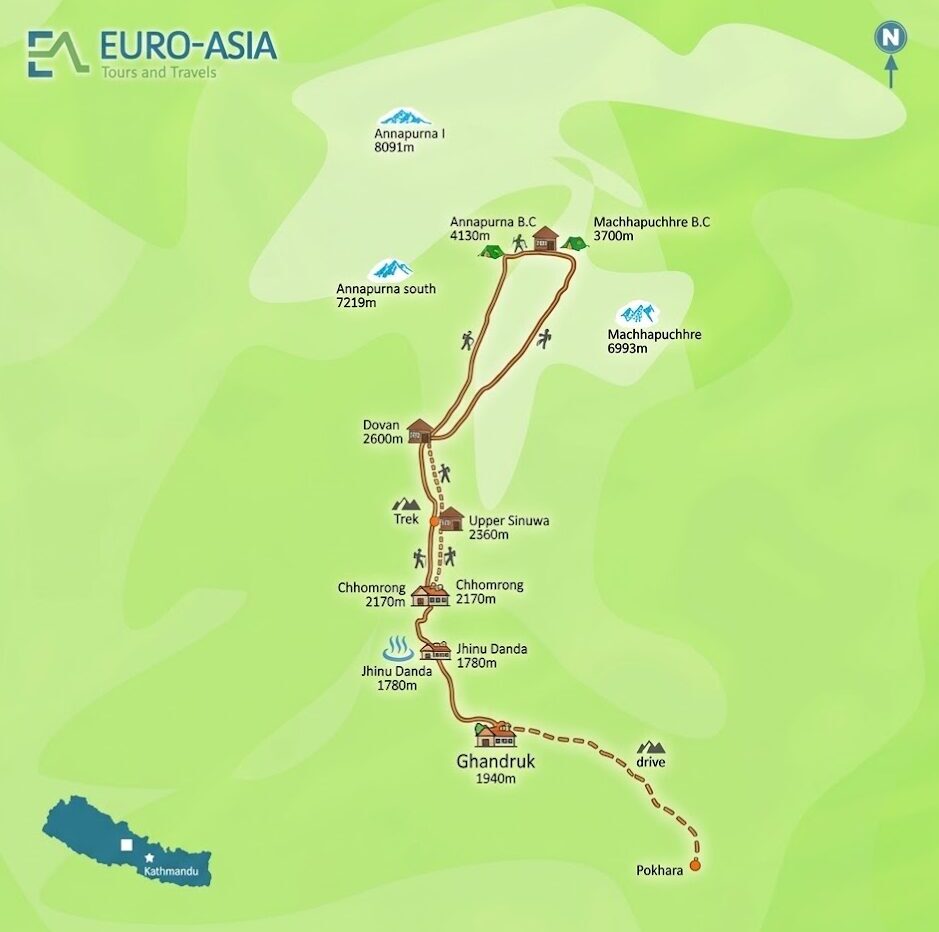 This route approaches Annapurna Base Camp through Ghandruk and returns towards Pokhara through Jhinu. Road transfers cover the beginning and end, while the middle stages follow trekking trails.
Route from Pokhara Through Ghandruk
|
Stage |
Route |
|
Outward road transfer |
Pokhara to Ghandruk |
|
Trek towards base camp |
Ghandruk → Chhomrong → Dovan → Machhapuchhre Base Camp → Annapurna Base Camp |
|
Return trek |
Annapurna Base Camp → Sinuwa → Chhomrong → Jhinu |
|
Return road transfer |
Accessible pickup point near Jhinu to Pokhara |
This itinerary does not include Ghorepani or Poon Hill. Adding either destination requires a revised route and schedule.
Walking Distance and Daily Variations
Walking distance depends on the exact trail, overnight accommodation, and vehicle pickup points. Road kilometres should remain separate from trekking distances when comparing itineraries.
Use the daily itinerary’s distance ranges for planning. Staying in Lower Sinuwa lengthens Day 6 but shortens the following day’s walk towards Jhinu. Lodge locations and vehicle pickup points affect the final distances.
Distance alone does not explain how demanding a stage feels. Steps, repeated climbs, trail conditions, and altitude also influence walking time.
What to Check on Your Trekking Map
Use a map that shows Ghandruk as the starting village and Jhinu as the return connection. It should distinguish vehicle transfers from walking sections and label every overnight stop.
Check the sleeping-altitude profile alongside the route map. A route can appear short horizontally while involving a substantial climb between overnight stops.
7-Day Annapurna Base Camp Trek Itinerary
The daily breakdown below covers walking conditions, overnight stops, meals, and practical preparation.
| Day | Route |
| Day 1 | Drive from Pokhara to Ghandruk by local jeep |
| Day 2 | Trek from Ghandruk to Chhomrong |
| Day 3 | Trek from Chhomrong to Dovan |
| Day 4 | Trek from Dovan to Machhapuchhre Base Camp |
| Day 5 | Trek from Machhapuchhre Base Camp to Annapurna Base Camp |
| Day 6 | Trek from Annapurna Base Camp to Sinuwa |
| Day 7 | Trek from Sinuwa to Jhinu, then drive to Pokhara |
Overnight stops may change with altitude response, weather, trail access, and walking pace. Additional time may be needed above Dovan or during the long descent to Sinuwa.
Meal arrangements: Daily meal inclusions appear under each stage. Breakfast on Day 1 and dinner on Day 7 are excluded.
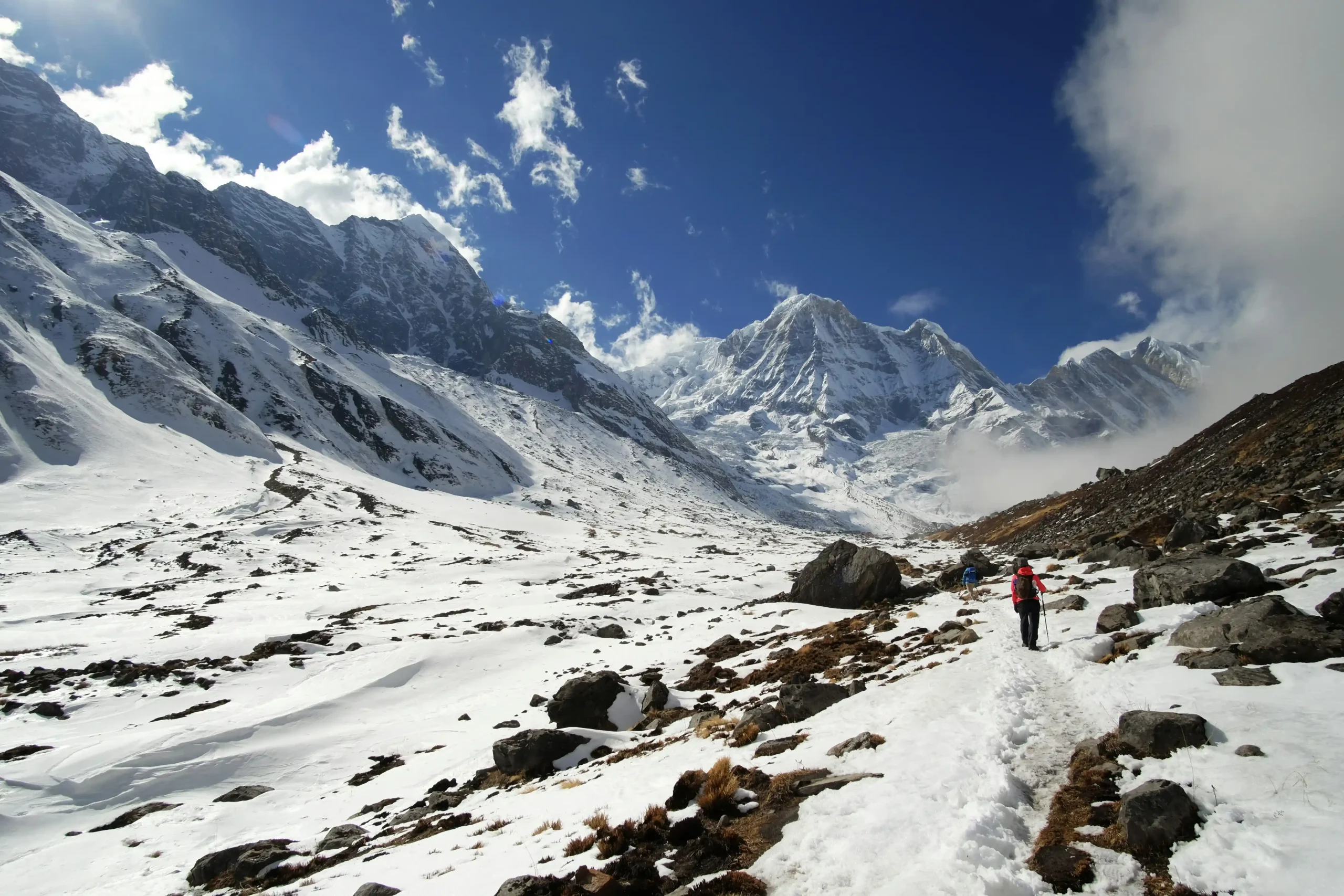
Day 1 — Drive from Pokhara to Ghandruk by Local Jeep
Your journey begins with a local jeep ride from Pokhara to Ghandruk. Confirm the meeting point and departure time beforehand, and eat breakfast before leaving because today’s breakfast is excluded.
Allow approximately 3–4 hours for the jeep journey, depending on road conditions, traffic, and stops. Walking from the vehicle drop-off point to your teahouse depends on road access and the accommodation’s location. Keep water, rain protection, and essential personal items accessible in your daypack.
After checking in, explore Ghandruk if arrival time permits. The village offers opportunities to learn about Gurung culture. Visit the cultural museum mentioned in the Nepal Tourism Board’s Ghandruk guide.
Use the evening to organise your equipment and discuss the next day’s walk to Chhomrong.
- Transport: Local jeep from Pokhara to Ghandruk.
- Walking: Transfer to the teahouse and optional village exploration.
- Overnight: Teahouse in Ghandruk.
- Meals: Lunch and dinner included; breakfast excluded.
Day 2 — Trek from Ghandruk to Chhomrong
After breakfast, leave Ghandruk for your first full trekking day. The route through Kimrong Khola involves descending towards the river before climbing towards Chhomrong. These repeated climbs and descents make the walk more demanding than the difference between village elevations suggests. Route reference
Walk at a steady pace and take short breaks during the uphill sections. Keep your rain jacket and drinking water accessible rather than buried inside your main luggage. Your lunch stop will depend on progress and the trail followed.
On arrival, settle into your teahouse and prepare for the next day’s walk to Dovan. Check your feet for rubbing and dry damp clothing before repacking.
- Walking time: Allow approximately 5–6 hours, depending on the route, pace, and breaks.
- Walking distance: Approximately 9 km via Kimrong Khola, depending on the selected trail and lodge locations.
- Overnight elevation: Approximately 2,170 metres, varying with the lodge’s position.
- Terrain: Stepped paths, river-valley descent, and sustained uphill sections.
- Overnight: Teahouse in Chhomrong.
- Meals: Breakfast, lunch, and dinner included.
Day 3 — Trek from Chhomrong to Dovan
After breakfast, descend the stone steps from Chhomrong towards Chhomrong Khola. Cross the river before climbing towards Sinuwa, then continue through forest towards Bamboo and Dovan. The route combines repeated climbs with shaded woodland walking.
Take your time on the opening descent rather than rushing to keep pace with other trekkers. Save energy for the climb towards Sinuwa, and watch your footing on wet steps and exposed roots. Arrange lunch around your progress, with breaks before you become overly tired.
At Dovan, settle into your teahouse and change out of damp clothing. Discuss tomorrow’s ascent to Machhapuchhre Base Camp with your guide. Review whether an intermediate overnight stop is needed.
- Walking time: Approximately 5–7 hours, depending on pace, breaks, and trail conditions.
- Walking distance: Approximately 9 km via Sinuwa and Bamboo, depending on your lodge locations and the trail followed.
- Overnight elevation: Approximately 2,600 metres.
- Terrain: Stone staircases, a river crossing, forest trails, and repeated ascents and descents.
- Overnight: Teahouse in Dovan.
- Meals: Breakfast, lunch, and dinner included.
Day 4 — Trek from Dovan to Machhapuchhre Base Camp
Leave Dovan after breakfast and follow the valley towards Himalaya and Deurali. Beyond Deurali, the landscape becomes more open as you approach Machhapuchhre Base Camp, commonly shortened to MBC. Forest sections give way to rockier ground, with mountain views depending on cloud cover.
Keep warm layers and rain protection accessible as conditions change along the valley. Follow current local guidance around exposed sections, particularly when snow or recent heavy rainfall affects the trail.
This stage requires careful altitude planning. Moving from approximately 2,600 metres to 3,700 metres means a sleeping-altitude increase of roughly 1,100 metres. That is a substantial gain requiring review before departure, with an intermediate overnight stop considered when planning.
Do not ascend further with symptoms of altitude illness. Worsening symptoms require descent and medical assistance. Walking slowly does not replace a gradual ascent schedule. CDC altitude guidance
- Walking time: Approximately 6–8 hours, depending on pace and trail conditions.
- Walking distance: Approximately 8–12 km via Himalaya and Deurali.
- Planned overnight elevation: Approximately 3,700 metres.
- Terrain: Forest paths, sustained climbing, and increasingly open, rocky sections.
- Main stops: Himalaya and Deurali.
- Planned overnight: Teahouse at Machhapuchhre Base Camp, subject to itinerary review.
- Meals: Breakfast, lunch, and dinner included.
Day 5 — Trek from Machhapuchhre Base Camp to Annapurna Base Camp
After breakfast, follow the rising trail from MBC towards Annapurna Base Camp. This stage is shorter, but the altitude still requires a steady pace. Pay attention to how you feel.
The route crosses open terrain, where wind, cloud, or snow can affect progress. Keep your warm layers, gloves, and sun protection accessible. When visibility allows, the surrounding mountain slopes become the main feature of the walk.
On arrival, check into your teahouse and rest before any gentle exploration nearby. Your itinerary includes an overnight stay at ABC, so there is no planned descent that afternoon. Mountain views and the following morning’s sunrise depend on weather conditions.
Continue upwards only if you are well. Do not ascend with altitude-illness symptoms, and descend if symptoms worsen.
- Walking time: Approximately 2–3 hours, depending on pace and trail conditions.
- Walking distance: Approximately 3–4 km from MBC to ABC, depending on lodge locations and the trail followed.
- Planned overnight elevation: Approximately 4,130 metres.
- Sleeping-altitude gain: Approximately 430 metres from MBC.
- Terrain: Open uphill trail, with possible snow or ice depending on conditions.
- Overnight: Teahouse at Annapurna Base Camp.
- Meals: Breakfast, lunch, and dinner included.
Day 6 — Trek from Annapurna Base Camp to Sinuwa
If skies are clear, enjoy the early mountain views before breakfast and departure. Today involves a long return walk, so leave enough daylight for breaks and the final approach to your lodge.
Retrace the trail through Machhapuchhre Base Camp, Deurali, Himalaya, Dovan, and Bamboo before continuing towards Sinuwa. The landscape changes from open mountain terrain to forest as you descend. However, the route includes uphill sections, so expect more than a continuous downhill walk.
Use controlled steps on steep descents and pause when your legs become tired. Keep snacks and water accessible, and discuss your progress with the guide throughout the day. An earlier overnight stop may be necessary if conditions or fatigue slow the group.
Overnight accommodation may be in Upper or Lower Sinuwa, depending on availability, conditions, and the group’s progress. Walking distance and arrival time vary accordingly.
- Walking time: Approximately 8–10 hours; slower groups may need longer.
- Walking distance: Approximately 18–24 km, depending on the trail and overnight location in Sinuwa.
- Starting elevation: Approximately 4,130 metres at ABC.
- Terrain: Sustained descents, stone steps, forest paths, and some uphill sections.
- Overnight: Teahouse in Upper or Lower Sinuwa, depending on availability and the group’s progress.
- Meals: Breakfast, lunch, and dinner included.
Day 7 — Trek from Sinuwa to Jhinu and Drive to Pokhara
After breakfast, leave Sinuwa and descend towards Chhomrong Khola before climbing the stone steps into Chhomrong. Continue downhill towards Jhinu, keeping a steady pace after the previous day’s long walk.
From Jhinu, walk to the confirmed vehicle pickup point for your return journey to Pokhara. The walking distance depends on road access and where the vehicle can meet you. Keep essential items in your daypack until you reach the vehicle.
A hot spring visit is optional and depends on access, available time, and the group’s energy. It requires additional walking, so discuss the detour before committing to a pickup time.
Road conditions and traffic can affect your arrival in Pokhara. Avoid arranging a tight onward connection that evening. Lunch is included today, while dinner is at your own expense.
- Walking time: Approximately 3–5 hours to the pickup area near Jhinu.
- Walking distance: Approximately 6–9 km, depending on your Sinuwa lodge and vehicle pickup point.
- Driving time: Approximately 3–4 hours from the pickup area near Jhinu to Pokhara. Poor road conditions or traffic can extend the journey.
- Terrain: Stone steps, river-valley descent, a climb to Chhomrong, and downhill walking towards Jhinu.
- Transport: Road transfer to Pokhara.
- End point: Pokhara.
- Meals: Breakfast and lunch included; dinner excluded.
How Difficult Is This Seven-Day Annapurna Base Camp Trek?
This seven-day route is physically demanding because it combines repeated climbs, consecutive trekking days, and substantial altitude gains. The long return from ABC to Sinuwa adds another challenge, particularly when your legs are already tired.
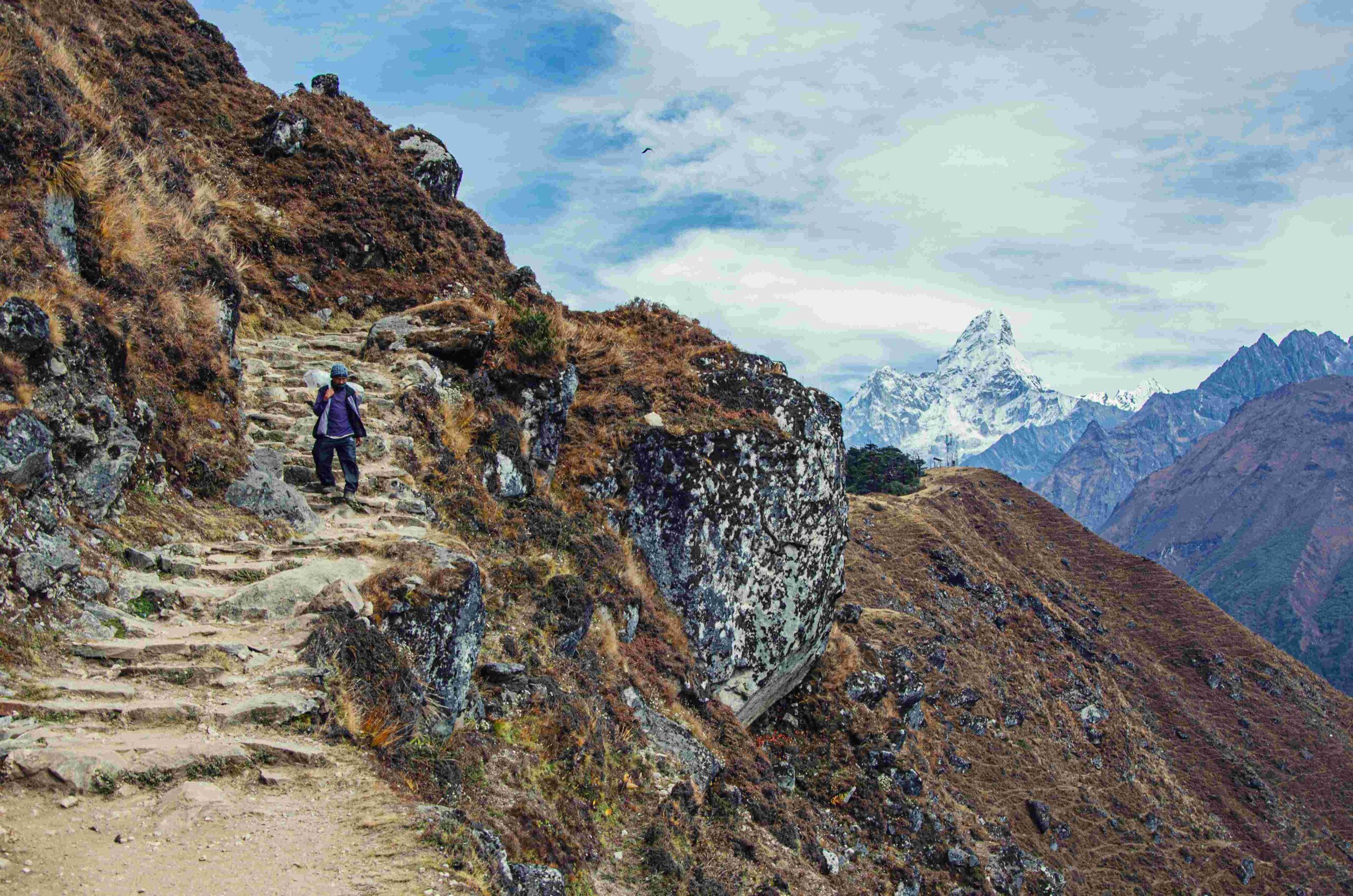
Stone Steps, Climbs and Consecutive Walking Days
Expect frequent changes between uphill and downhill walking. Around Chhomrong, descending towards the river means climbing again on the opposite side.
Your overnight elevations show only part of the effort involved. Two villages can sit at similar heights while the connecting trail crosses a deep valley.
Wet steps and uneven ground can also slow progress. Judge each stage by its terrain and walking demands, rather than distance alone.
The Long Return Stage from ABC to Sinuwa
Day 6 requires sustained walking after several days on the trail. Although you lose elevation overall, the route still includes uphill sections.
Long descents can feel demanding on tired legs, especially when carrying a heavy pack. Keep a manageable pace and discuss an earlier overnight stop if fatigue affects your footing.
Upper and Lower Sinuwa involve different finishing points. Your overnight location depends on availability, conditions, and the group’s progress.
Fitness Preparation and Beginner Suitability
Prepare through regular walks, stair climbing, and longer outings on uneven ground. Gradually practise consecutive walking days with the daypack and footwear you intend to use.
Include downhill walking during preparation, rather than training only on flat routes. Test your boots early and address rubbing before departure.
Beginners should assess the actual itinerary instead of relying on a general difficulty label. A longer schedule may suit travellers who need shorter stages or more flexibility.
Fitness helps with physical effort but does not prevent altitude illness. Sleeping-altitude progression requires separate consideration when planning your trek.
Sleeping Altitudes and Acclimatisation
This itinerary’s main altitude concern is the planned ascent from Dovan to Machhapuchhre Base Camp in one day. Review that stage before booking, rather than waiting for symptoms to decide whether the schedule needs adjustment.
Overnight Elevation Along the Route
Sleeping altitude matters because your body remains exposed to reduced oxygen throughout the night. These approximate elevations describe the planned stops; individual lodge locations can differ.
|
Overnight stop |
Approximate elevation |
|
Ghandruk |
Around 2,000 metres |
|
Chhomrong |
Around 2,170 metres |
|
Dovan |
Around 2,600 metres |
|
Machhapuchhre Base Camp |
Around 3,700 metres |
|
Annapurna Base Camp |
Around 4,130 metres |
|
Sinuwa |
Varies between Upper and Lower Sinuwa; the overnight stop depends on availability and the group’s progress. |
Altitude Progression from Dovan to MBC and ABC
The planned Dovan–MBC stage increases sleeping altitude by approximately 1,100 metres. The following night at ABC added another 430 metres.
Gradual sleeping-altitude gains are important on this route. CDC altitude guidance recommends limiting sleeping-altitude increases to 500 metres daily above 3,000 metres. It also recommends an additional acclimatisation day for every 1,000 metres gained.
The Dovan–MBC stage therefore deserves particular scrutiny. Discuss a revised ascent with intermediate overnight stops and additional time where needed.
A shorter walk from MBC to ABC does not cancel the previous day’s substantial altitude gain.
When the Itinerary Needs Adjustment
Tell your guide promptly about headache, nausea, dizziness, or unusual fatigue after ascending. Do not continue to a higher sleeping altitude while experiencing symptoms of altitude illness.
If symptoms worsen despite resting at the same elevation, descend and seek medical help. Confusion, difficulty walking normally, or breathlessness at rest require urgent assistance and descent. Keep additional days available and clarify how itinerary changes affect accommodation, staffing, transport, and costs. A fixed booking or return flight should never determine whether you continue ascending.
Annapurna Base Camp Trek Cost and Extra Expenses
The seven-day Annapurna Base Camp Trek costs NPR 54,500 per person, based on two people booking together. The total for two travellers is NPR 109,000. This covers the planned journey starting and ending in Pokhara.
Request a written quotation confirming the exact services before booking.
|
Feature |
Details |
|
Price per person |
NPR 54,500, based on two people booking together |
|
Duration |
Seven days |
|
Starting and ending point |
Pokhara |
|
Accommodation |
Six planned nights in teahouses |
|
Transport |
Jeep to Ghandruk and return transfer from the Jhinu area |
|
Trekking support |
Guide and porter services |
|
Permit allowance |
ACAP permits; confirm any additional required fees |
|
Meals |
Lunch on Day 1 through lunch on Day 7 |
Included Meals
Meal arrangements follow your seven-day itinerary:
-
Day 1: Lunch and dinner.
-
Days 2–6: Breakfast, lunch, and dinner.
-
Day 7: Breakfast and lunch.
Breakfast on Day 1 and dinner on Day 7 are excluded. Confirm whether drinks and drinking water are included in your quotation.
Additional Expenses
Budget separately for personal expenses unless your quotation includes them. These may include snacks, drinks, hot showers, charging, Wi-Fi, equipment rental, and tips.
Kathmandu–Pokhara travel, travel insurance, and Pokhara stays outside the itinerary require separate arrangements. Confirm any optional Jhinu hot spring charges before visiting.
Additional trekking days or changed transport may affect the total cost. Ask how extra accommodation, meals, guide services, and porter support would be charged. Review our booking conditions for payment, cancellation, and insurance information.
Best Time for This Annapurna Base Camp Itinerary
Spring and autumn generally offer more favourable conditions for this route. However, your travel month cannot guarantee clear views, dry trails, or uninterrupted road access.
Seasonal conditions vary with elevation and location. The Nepal Tourism Board’s climate guide provides background on Nepal’s seasons and rainfall patterns.
Spring Conditions: March to May
Spring brings warmer conditions on lower trails, while nights near the base camps remain cold. Rhododendron flowering can add colour to forest sections, although timing varies with elevation and weather.
Pack layers for the difference between walking temperatures and cold evenings. Check recent snow conditions before the upper stages, particularly earlier in the season.
Autumn Conditions: September to November
October and November generally offer clearer skies after the monsoon. September can still receive monsoon rainfall, so early autumn requires flexibility around trail and road conditions.
Arrange accommodation ahead for popular trekking dates. As autumn progresses, prepare for colder nights, especially at MBC and ABC.
Monsoon Conditions: June to September
Monsoon rainfall can make stone steps slippery and obscure mountain views. Heavy rain can also disrupt access roads and affect walking schedules.
For this itinerary, delays can make already demanding stages harder to manage. Protect clothing inside waterproof bags and allow additional time instead of relying on a fixed seven-day completion.
Winter Conditions: December to February
Winter brings colder nights and possible snow or ice on higher sections. Clear weather does not necessarily mean the trail is suitable for travel.
Confirm upper-route access and lodge availability close to departure. Snow conditions may require different equipment, revised overnight stops, or postponement.
Before leaving Pokhara, check recent trail conditions, road access, and lodge availability with your trekking organiser.
Permits, Guides and Porters
Arrange permits and staffing before leaving Pokhara. Your quotation should clearly state which documents, fees, and support services are included.
Permit Requirements and Documents
This route enters the Annapurna Conservation Area, which requires an entry permit, commonly called the ACAP permit.
|
Traveller category |
Published conservation-area entry fee |
|
Foreign nationals outside SAARC |
NPR 3,000 per person |
|
SAARC nationals |
NPR 1,000 per person |
|
Nepali nationals |
NPR 100 per person |
|
Children below 10 |
Free entry |
Permit fees depend on nationality and traveller category. Check the Nepal Tourism Board’s published entry fees before departure.
Nepal Tourism Board also lists Poon Hill–ABC under its licensed-guide and agency-issued TIMS requirements. Published TIMS charges are NPR 1,000 for SAARC applicants and NPR 2,000 for other foreign applicants. Check the official TIMS requirements and confirm their application to your Ghandruk–ABC route.
Ask your agency which passport details, photographs, and supporting information it needs. Check that issued documents match your identity and planned route, and keep them accessible for inspections.
Guide Arrangements
Confirm your guide’s licence, communication language, relevant route experience, and first-aid training before booking. Ask how the guide coordinates accommodation, itinerary changes, and emergency support.
For this schedule, discuss the Dovan–MBC ascent and the long return to Sinuwa before departure. Guide support does not replace an appropriate acclimatisation schedule.
Porter Support and Baggage Allowance
Confirm your baggage allowance and the total load assigned to each porter before packing.
Ask whether quoted staffing costs include wages, meals, accommodation, suitable equipment, and insurance.
Keep water, warm layers, rain protection, medication, and valuables in your own daypack. You may not have access to porter-carried luggage throughout the walking day.
Teahouses, Food and Drinking Water
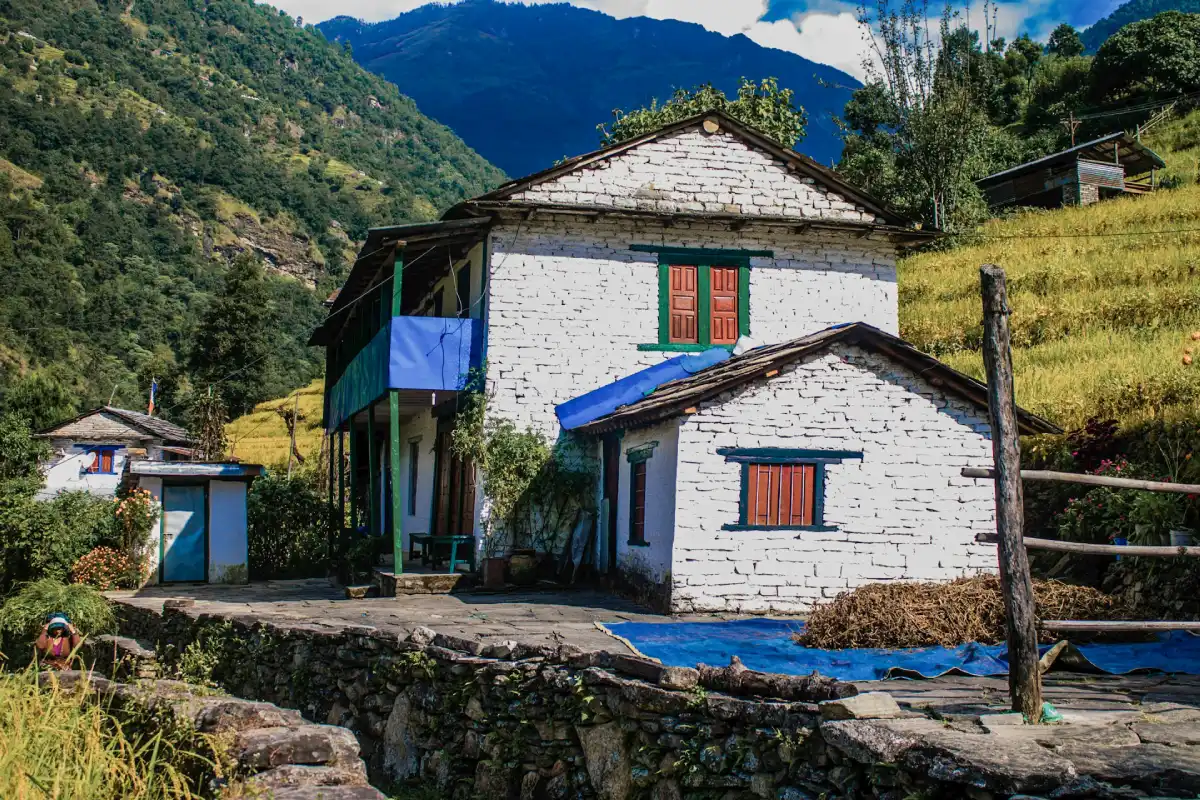
Expect basic teahouse accommodation, with facilities varying between villages, lodges, and higher overnight stops.
Rooms, Bedding and Shared Facilities
Prepare for simple rooms and shared bathrooms, particularly higher on the route. Private rooms or attached bathrooms should only be expected when specifically confirmed.
Ask whether your teahouses provide blankets and whether you need to bring or rent a sleeping bag.
Hot showers may cost extra or be unavailable. Carry your own toiletries, toilet paper, and a small towel.
Meals and Dietary Requests
Teahouse menus commonly include dal bhat, soups, noodles, potatoes, eggs, and breakfast dishes. Available choices depend on the lodge and supplies, so expect some repetition.
Tell your organiser about dietary requirements before departure and remind the lodge when ordering. For allergies, explain the specific ingredients involved and ask about shared cooking utensils.
Do not assume specialist products or separate preparation areas are available. Carry suitable backup snacks if your dietary needs limit your choices.
Drinking Water and Refill Arrangements
Bring reusable bottles and confirm how drinking water will be supplied throughout the trek. Ask whether boiled or treated refills are available and included in your quotation.
Do not assume untreated tap or stream water is safe because it looks clear. If carrying a treatment product, follow its instructions, including treatment time and limitations.
Check refill arrangements each evening so you can leave with enough water for the next stage. Keep some water accessible while walking rather than packing every bottle with your main luggage.
Transport and Practical Planning from Pokhara
Arrive in Pokhara before your departure day so you have time to confirm transport, check equipment, and organise luggage.
Pickup, Jeep Travel and Changing Roadheads
Confirm your meeting point, departure time, and whether the local jeep collects you from your accommodation. Ask whether reaching the departure point requires a separate transfer.
Confirm whether your transfers use reserved vehicles or seats in shared local jeeps. Keep documents, medication, and valuables with you.
For the return, confirm the accessible pickup point near Jhinu with your guide. Changes in road access may add walking or delay your arrival in Pokhara.
Cash, Charging and Communication
Carry enough Nepali rupees for expected extras and additional days. Bring smaller notes and avoid relying entirely on card payments or cash withdrawals along the trail.
Charge your devices before departure and carry a power bank. Confirm charging prices at each lodge rather than assuming electricity is included with your room.
Download essential documents, contact details, and maps for offline access. Tell family that communication may be irregular, and agree on a contact plan before trekking.
Luggage Storage and Onward Travel
Ask your Pokhara accommodation whether it can store luggage during the trek. Confirm charges, collection arrangements, and any restrictions before leaving bags behind.
Label stored luggage and keep your passport, valuables, and essential medication with you. Carry only the clothing and equipment needed for the trek.
Leave flexibility between returning to Pokhara and your next departure. A planned arrival time should not become a reason to rush the final walking stage.
Insurance and Emergency Arrangements
Ask your insurer to confirm coverage for your planned trekking altitude, medical treatment, and emergency evacuation. Check exclusions, claim procedures, and whether advance authorisation is required.
Give your organiser your policy details and emergency contact information. Keep an offline copy and carry the insurer’s assistance number yourself.
Before departure, ask how your guide contacts support when mobile reception is unavailable. Clarify who coordinates assistance and how payment or insurer approval is handled.
Do not assume helicopter evacuation will always be available immediately. Weather, location, and operating conditions can affect rescue options.
What to Pack for Seven Days
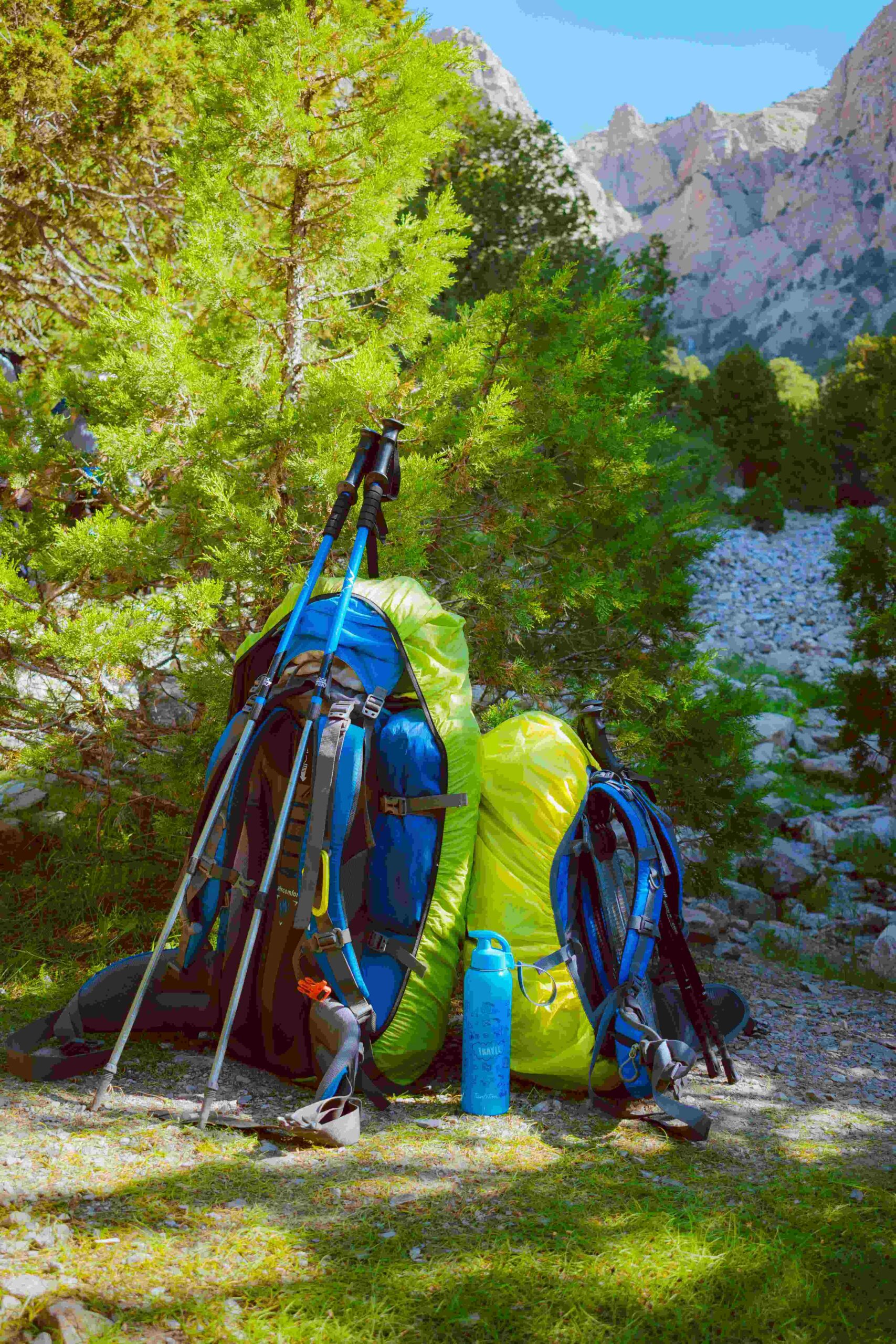
Pack for warm walking conditions, cold evenings, and possible rain or snow higher on the route. Choose equipment for your travel season and keep your load within the confirmed baggage allowance.
Clothing and Footwear
Bring layers you can adjust without unpacking your entire bag.
-
Base layers: Quick-drying tops and thermal layers for colder conditions.
-
Warm layers: A fleece and insulated jacket for rest stops and evenings.
-
Weather protection: A waterproof jacket and trousers.
-
Walking trousers: Comfortable trousers that allow easy movement on steps.
-
Footwear: Well-fitting trekking boots or shoes with suitable grip, already tested on longer walks.
-
Socks: Spare pairs, including a dry pair reserved for evenings.
-
Accessories: A warm hat, gloves, sun hat, and sunglasses.
-
Lodge footwear: Lightweight sandals or shoes for use after trekking.
Avoid packing a completely fresh outfit for every day. Prioritise keeping one set of sleeping clothes dry.
Daypack Essentials
Carry items you may need before reaching your overnight lodge.
|
Item |
Why to carry it |
|
Reusable water bottles |
Keep drinking water accessible between stops |
|
Rain protection and warm layer |
Respond to changing weather without accessing porter-carried luggage |
|
Sunscreen and lip protection |
Protect exposed skin during outdoor walking |
|
Headlamp and spare power |
Manage poorly lit lodge areas or unexpected delays |
|
Personal medication |
Keep essential supplies with you throughout the day |
|
Blister supplies |
Address rubbing before it becomes more uncomfortable |
|
Snacks |
Cover gaps between meal stops |
|
Documents and cash |
Keep permits, identification, and personal spending money accessible |
|
Waterproof bags |
Protect electronics, documents, and spare clothing |
Trekking poles may help you manage repeated steps and long descents. Practise using them before departure.
Sleeping Equipment and Rental Items
Choose a sleeping bag with a comfort rating suitable for expected overnight temperatures.
Confirm whether Euro Asia provides any sleeping equipment, jackets, poles, or luggage bags. Do not assume these items are included.
For rentals, check fit, cleanliness, working zips, deposits, and return conditions before leaving Pokhara. Ask separately whether current snow conditions require additional traction equipment.
Frequently Asked Questions
Does the Seven-Day Itinerary Include Travel from Kathmandu?
No. These seven days start and end in Pokhara, including the transfers to Ghandruk and from the Jhinu area. Arrange Kathmandu–Pokhara travel separately and arrive before the trek’s departure day.
Does This Route Include Poon Hill?
No. This itinerary follows Ghandruk, Chhomrong, Dovan, MBC, and ABC before returning through Sinuwa and Jhinu. Visiting Poon Hill requires a revised route and additional time.
Will We Sleep at Both MBC and Annapurna Base Camp?
Yes, the proposed itinerary includes one night at each base camp. However, the ascent schedule requires review, and overnight stops may change according to conditions and altitude response.
Is Sinuwa the Same as Upper Sinuwa?
Sinuwa includes Upper and Lower Sinuwa, which are separate stopping points along the route. Your overnight stay may be in either location, depending on availability and the group’s progress. Daily walking estimates allow for this variation.
Are Private Rooms Available Throughout the Trek?
Do not assume private rooms are available at every overnight stop. Ask which arrangements can be confirmed and where sharing may be necessary, particularly at higher lodges.
How Much Does the Seven-Day Annapurna Base Camp Trek Cost for Two People?
The total is NPR 109,000 for two people, equivalent to NPR 54,500 per person. The seven-day itinerary starts and ends in Pokhara. Request a written quotation confirming inclusions, exclusions, and any additional permit fees. Extra days or itinerary changes may affect the total.
Is the Jhinu Hot Spring Visit Included?
The hot spring visit is optional within this proposed itinerary. Access, available time, and your return transfer determine whether the detour is practical. Confirm any entry charges separately.
What Happens if the Trek Takes Longer Than Seven Days?
Additional nights may affect accommodation, meals, staffing, and return transport costs. Agree on these arrangements before departure and keep onward travel flexible. Your planned finish date should not force you to continue when conditions require a change.
About the Author
Euro Asia Tours & Travels is a Kathmandu-based tour operator established in 1995. Our team plans trekking itineraries and customised holidays across Nepal. Learn more about Euro Asia’s company background.
Plan Your Annapurna Base Camp Trek
Planning your Annapurna Base Camp Trek starts with choosing a schedule that matches your experience and available time. Share your travel dates, group size, and previous trekking experience with Euro Asia Tours & Travels.
Ask about the seven-day arrangement priced at NPR 54,500 per person, based on two people booking together. We can review the walking stages together and discuss whether you need additional days.
Request a written quotation covering meals, inclusions, exclusions, and charges for additional days. Contact Euro Asia Tours & Travels with your travel dates and group size.